
MOSS-Image on a 12 GB card: Base, SFT and an anime fine-tune, side by side
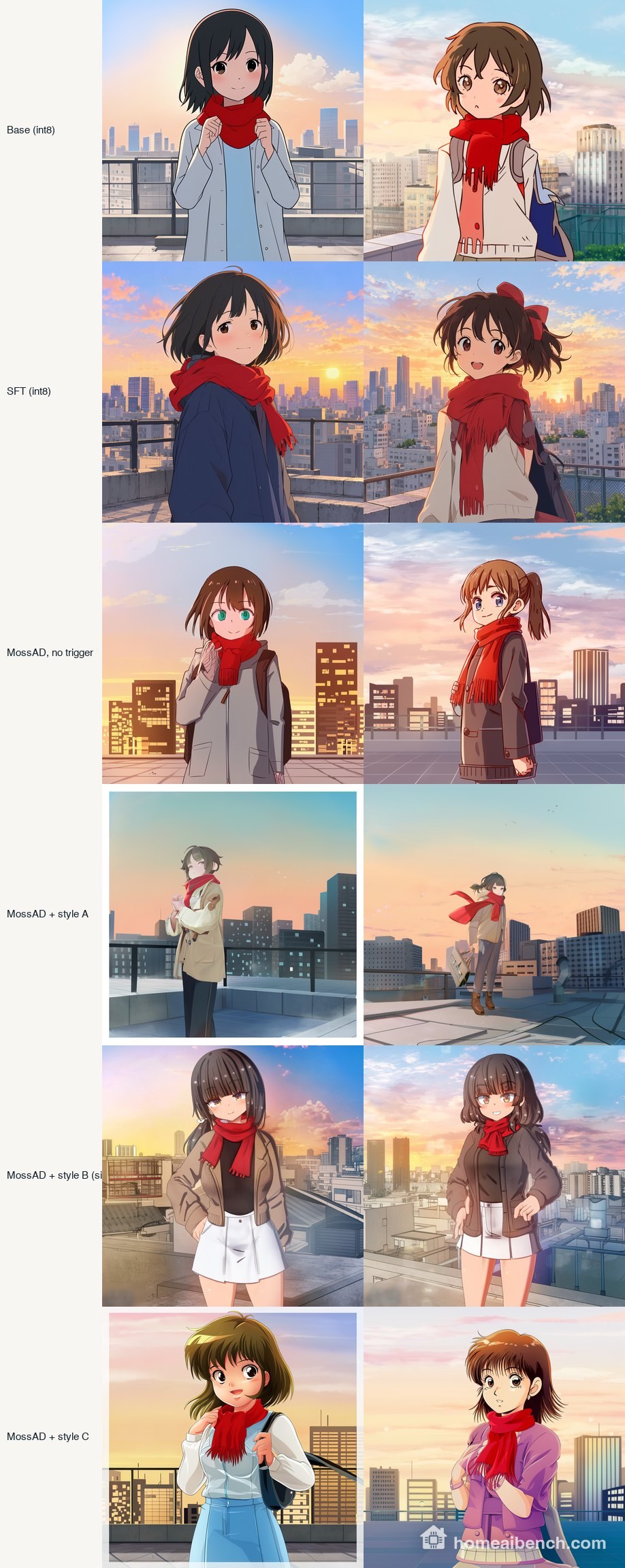
MOSS-Image is a 5-billion-parameter text-to-image model from OpenMOSS, released in October 2026 under the Apache-2.0 license. Within days there were dozens of derivatives on Hugging Face. The one people kept pointing at for anime is MossAD-Demo, a third-party full fine-tune of the Base model on a small set of artist-style images. We wanted to see what it does to the same prompt, so we put it next to the two official models on a rented RTX 5070 with 12 GB of VRAM.
What we ran
Everything below used one machine and one set of settings: 1024×1024, 25 steps, the er_sde sampler, CFG 2.5, and the negative prompt from ComfyUI's MOSS-Image template ("nsfw, worst quality, bad anatomy, watermark, jpeg artifact"). ComfyUI v0.42.1 has native MOSS-Image support. The text encoder was Qwen3.5 9B with 4-bit weights (7.3 GB).
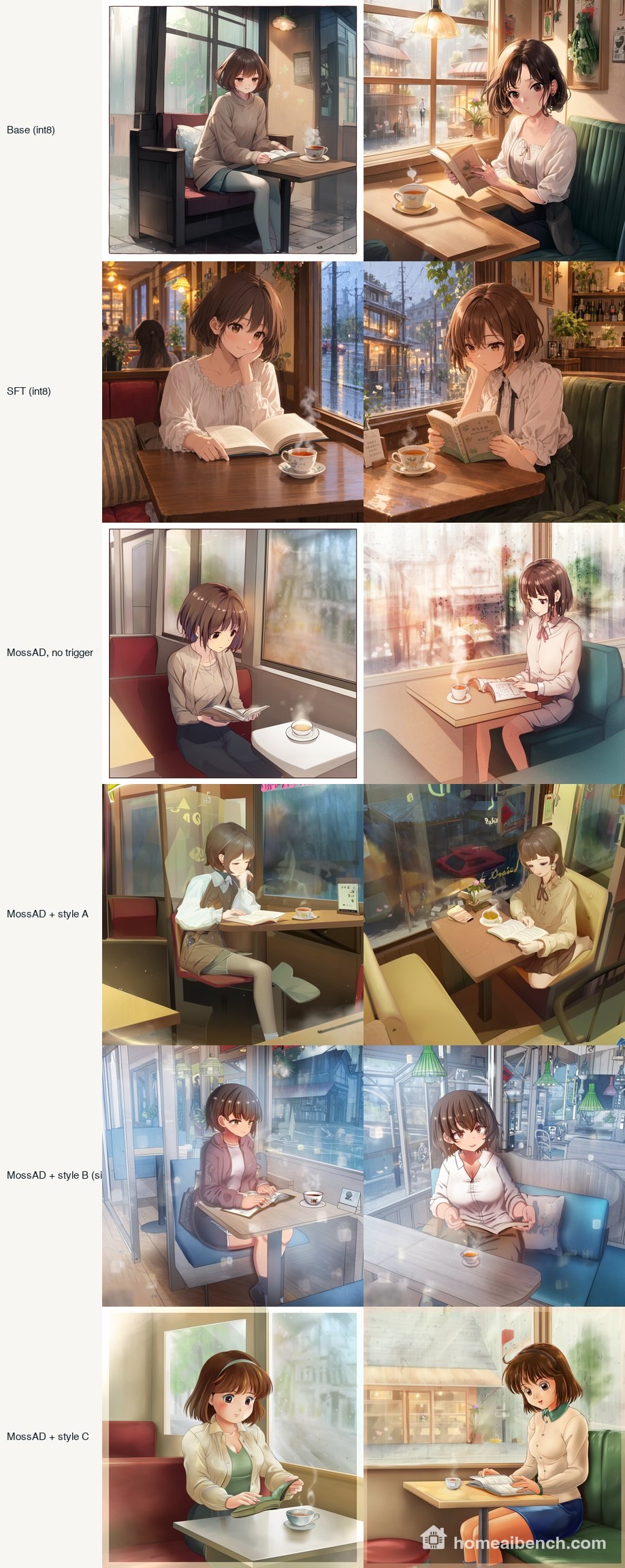
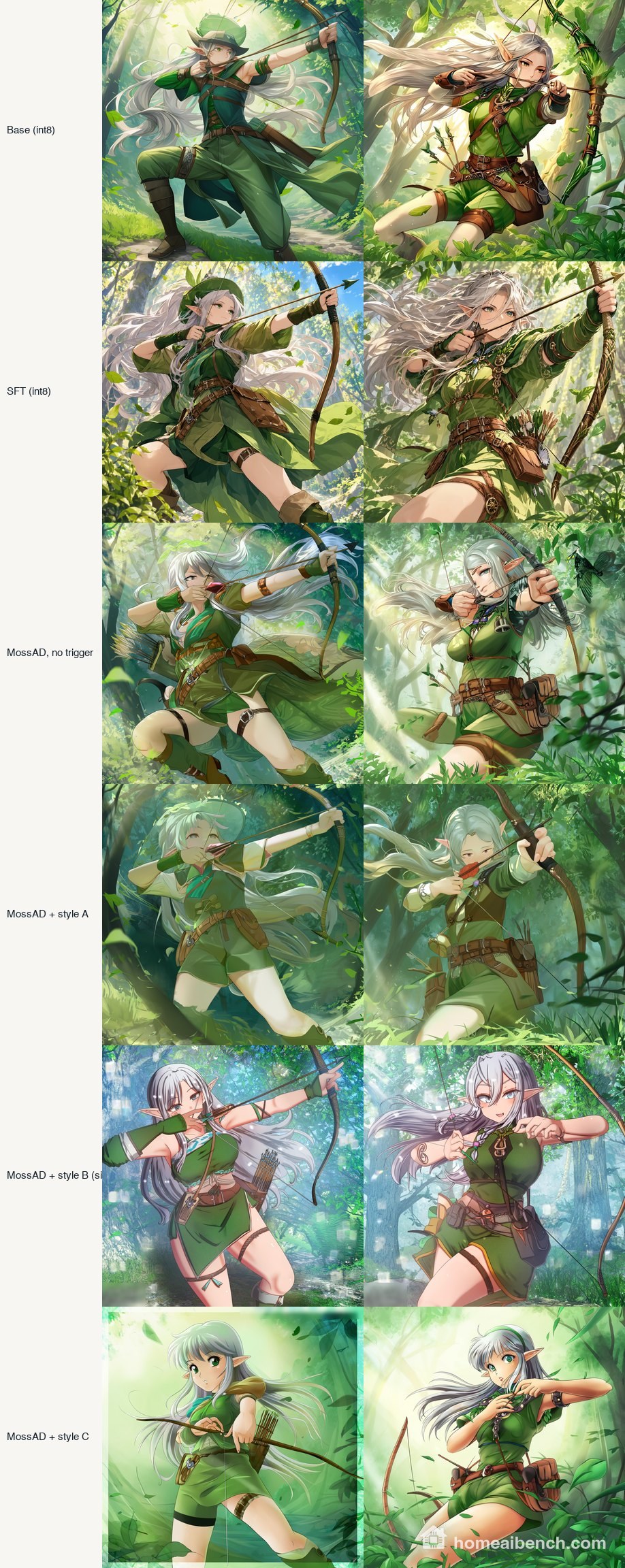
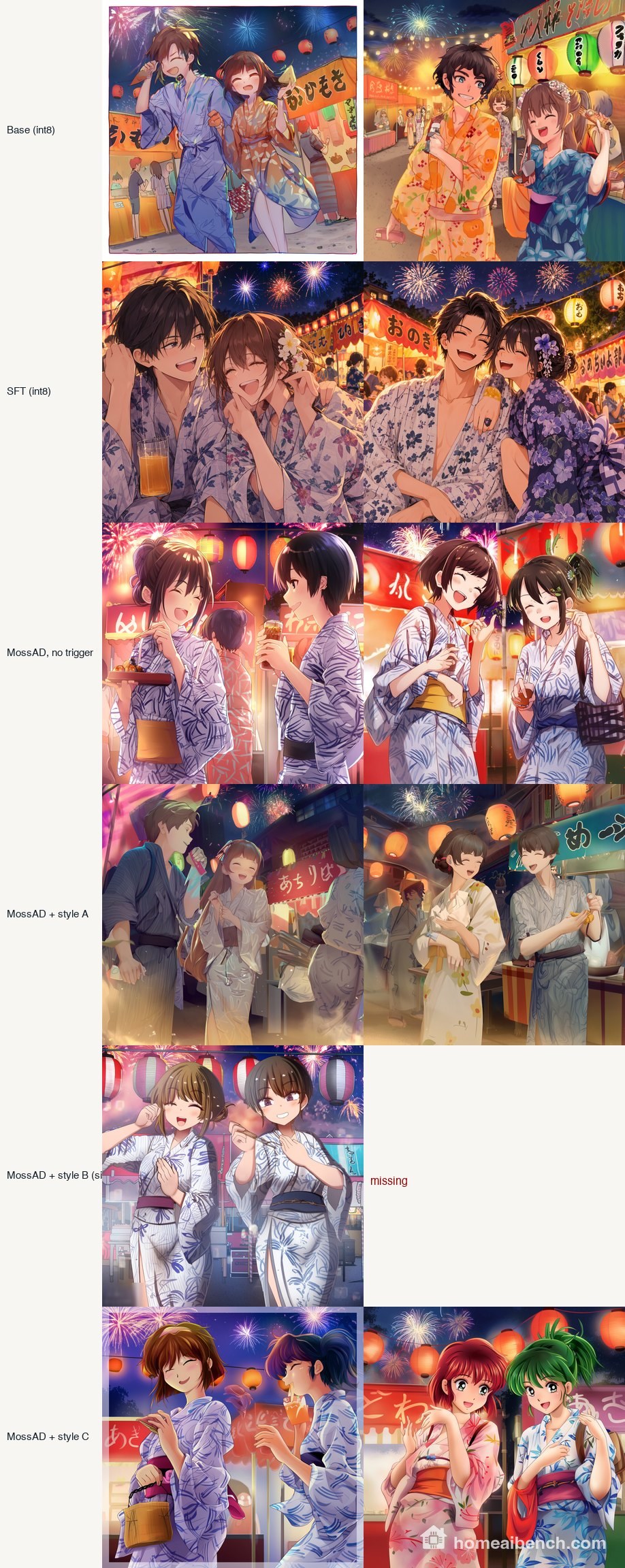
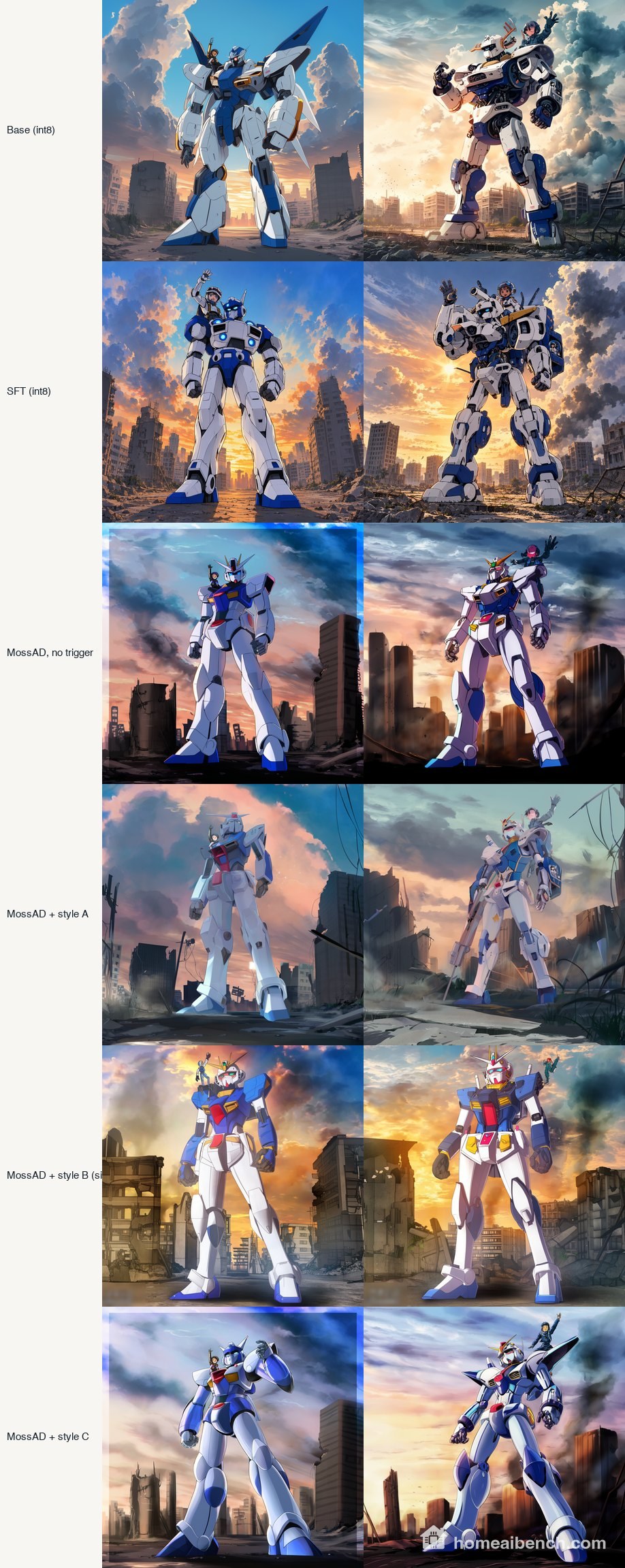
Six variants: Base and SFT (the official post-trained version), both as int8 files of 5.4 GB; MossAD with no style trigger; and MossAD with three different style triggers. MossAD's style is selected by putting @name of one of 57 artists at the start of the prompt. We do not print those names here. Five prompts, two seeds each: a rooftop at sunset, a rainy café, an elf archer, a summer festival, and a giant white and blue robot.
| Variant | File size | Median time per image |
|---|---|---|
| Base (int8) | 5.4 GB | 15.7 s |
| SFT (int8) | 5.4 GB | 15.7 s |
| MossAD, any trigger (bf16) | 10.2 GB | 45 s (45.0 to 45.6 s) |
The MossAD rows are three times slower, but this is not a fair speed test: it is a different file format and twice the size. A 10.2 GB model plus a text encoder does not fit comfortably in 12 GB, so the tool may have been moving parts in and out of memory. We did not look at memory use, so we cannot say that is the reason.
The pictures
Each sheet is one prompt. Columns are two seeds, rows are the variants.
What we noticed
- The official models follow the prompt well. All three subjects (scarf, tea cup, bow) survive in nearly every image. SFT tends to move the camera closer and add richer light and background. Base is plainer and sometimes leaves a white border around the picture.
- MossAD without a trigger is already a different look from Base. Faces are rounder and shading is more painted, even with no style requested. That fits a model fine-tuned only on a small set of anime illustrations, but we did not test anything outside anime.
- A trigger changes the picture a lot. The same seed gives a different character, a different pose and a different composition. Style A is soft and painterly with smaller figures; style C has larger eyes and brighter hair colours. We cannot say which one is "right": the triggers name real artists and we have not seen their work next to these results.
- Some MossAD images have a pale frame at the edge (style C most often). We did not find out why.
- Text is mixed. Festival signs have recognisable Japanese characters next to broken ones.
The signature problem
Style B reproduced a signature-like mark with a real artist's handle in the bottom-left corner in almost every image. MossAD's own model card warns about this: signatures and watermarks that most of an artist's images share can show up in generated pictures. We do not want to put a real person's name on pictures they did not make, so on this page we pixelated and blurred the lower-left corner of all nine style-B images. The masked area is the same box in every image and nothing else was changed. We found no readable text in the other variants.
This is a useful failure to know about: if you use an artist-trigger model, check the corners.
The settings may not suit MossAD
We used the settings from ComfyUI's template for the official models. MossAD's own page recommends different ones (Euler sampler, 30 steps, CFG 5), so the MossAD rows may not show it at its best. Second, we used only two seeds, so single differences are anecdotes. Third, this is one machine. We plan a second round with MossAD's own settings and memory measurements, which would also tell us whether the 45 s is a memory problem.
What others report
- A user on the SFT repository on Hugging Face reported regular vertical colour bands in SFT images and a small corrective patch (discussion). We did not look for these bands in our images and have not tested the patch.
- OpenMOSS's own README describes memory modes that trade speed for lower VRAM, which is how a 5B model plus a 9B text encoder can run on a consumer card (README).
- MossAD's author says the model was trained on 3,685 images from 57 artists, as a small pilot, and lists weaker hands and persistent watermarks as known problems (model card).
Licenses and limits
MOSS-Image Base and SFT are Apache-2.0. MossAD-Demo is also marked Apache-2.0 by its author, who is not part of OpenMOSS; we have not checked the rights to its training images and make no claim about them. We only ran the model and published pictures made with our own prompts (all suitable for all ages). The weights are not stored on this site.