
MOSS-Image in 8 steps: 4.5 times faster on a 12 GB card, and what changes in the picture
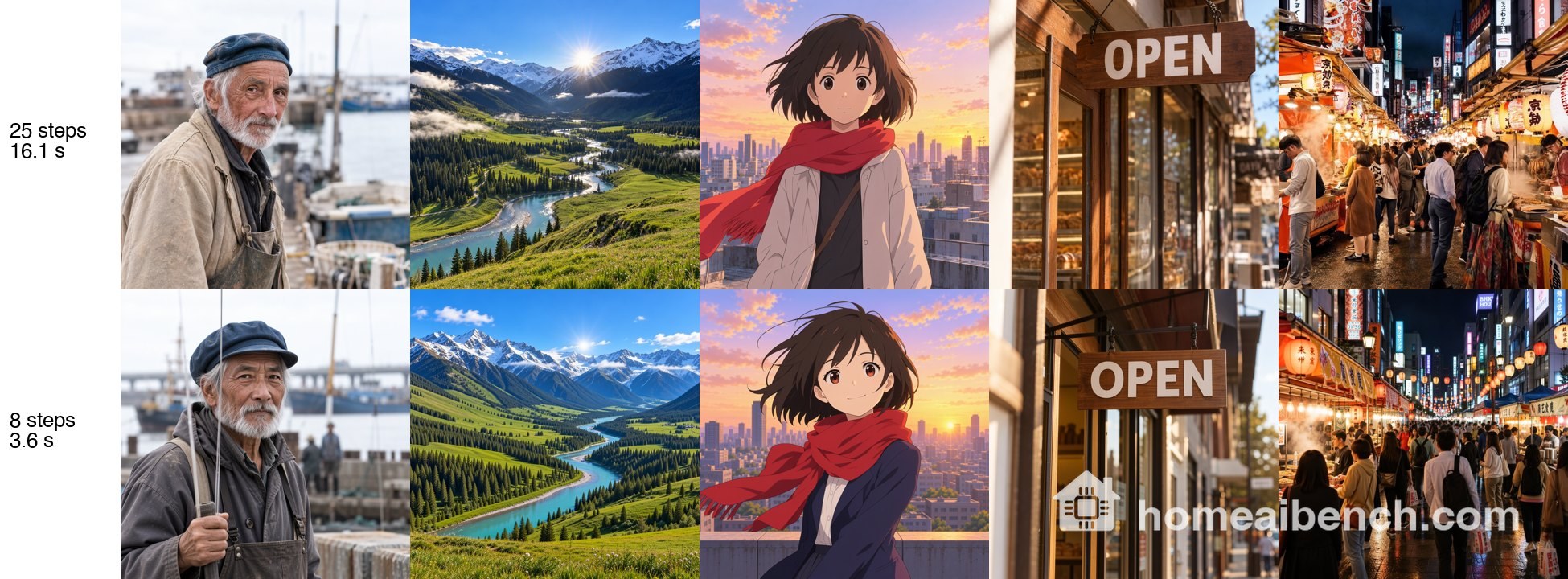
MOSS-Image is one of the few new open image models this autumn with a plain Apache-2.0 license, and we already had it in our comparison at the ComfyUI template settings. A Japanese column by Kazuhisa Nishikawa on TechnoEdge (26 October) pointed at a community LoRA that cuts the SFT model down to 8 steps. Speed is what this site measures, so we ran both on the same machine.
What we ran
- Model: MOSS-Image SFT, int8 weights repackaged by Comfy-Org, Qwen3.5 9B text encoder (w4a8), the small FLUX.2 VAE, ComfyUI v0.42.1. Apache-2.0.
- The LoRA: lodestones/MOSS-Image-SFT-8-steps-dmd, file
lora_latest.safetensors(1.19 GB), declared Apache-2.0. Its card describes it as a work-in-progress distillation of the SFT model from 50 steps with CFG 3 down to 8 steps without CFG. We used it at strength 0.7, the value in the column. - 25 steps: the ComfyUI template: er_sde sampler, simple scheduler, CFG 2.5, with the template's negative prompt.
- 8 steps: the same sampler, CFG 1.0, LoRA at 0.7.
- One rented RTX 5070 12GB, both settings interleaved on the same machine. Our standard prompt set in versions v1 and v2, seeds 300 and 301, 1024×1024: 20 pictures per setting, all of them succeeded.
Speed
| Setting | Median per picture | First picture |
|---|---|---|
| SFT, 25 steps | 16.1 s | 24.2 s |
| SFT + 8-step LoRA | 3.6 s | 4.8 s |
That is about 4.5 times faster. Peak VRAM was 11,597 MiB for the run (nvidia-smi, which includes memory PyTorch reserves). On a different RTX 5070 machine two days ago the 25-step setting took 15.4 s, so expect a few percent between machines.
What changes in the picture
The same seed does not give the same picture at 8 steps: pose, clothing and framing move. In the figure the fisherman changes his pose and gains a hand on a pole; the anime girl keeps her red scarf, short dark hair and sunset skyline but changes expression and outfit.
- Look: the 8-step row is a little more saturated and higher in contrast. The landscape becomes more orderly, with a smoother river curve and more regular bands of trees, where the 25-step version keeps low mist and irregular woodland. The column we followed found the 25-step result more three-dimensional, and on the ten v2 pairs we looked at, we see it the same way.
- Text: "OPEN" is spelled correctly on every sign at 8 steps, as it is at 25. In one 8-step picture (the v1 text prompt, seed 300) a second, made-up word appears on a sign in the background.
- Busy scene: both settings handle the crowded night market; the 8-step version tends to a longer, centred street with converging rows of lights.
How much to trust this
- One machine and twenty pictures per setting. The speed ratio should hold on other cards, but we have not measured it.
- We used one strength (0.7) and one file. The LoRA card itself recommends its other file,
lora.safetensors, at strength 1; we have not tried that. - The LoRA is a third-party work in progress. Its license is what its author declared; we have not checked its training data.
- We do not score quality. Look at the pairs yourself on the model page or in the comparison viewer.