
Holding a face in image-to-video: chains, gates, and one perfect reference

*Our still-image work holds one fixed character well enough. Video is where identity goes to die: not all at once, but a little of the face at a time, compounded across every clip in a chain.*
Our video work builds longer pieces from 10-second clips — we call them acts — all featuring the same fixed character. The recurring failure is identity drift. The face in the last frame of a clip is not quite the face in the first. Chain clips together, each one starting where the last ended, and the small differences compound until the person on screen is a stranger who resembles the character the way a cousin might. We have rejected acts whose opening face was inherited, already wrong, from the previous act's final frame. This note covers the two methods we use to fight that drift, the checking discipline around them, and the trial that showed the bottleneck, in our longest-running project, was not the video model at all.
The baseline: keyframed chains
Our standard route is image-to-video with Wan 3.0 on a hosted video API, at $0.65 per 10-second clip, 480p in portrait orientation. The important property is that the model accepts both a start frame and an end frame, and the clip lands on the end frame specified. The endpoint is pinned.
A film is built as a chain: each act's final frame becomes the next act's start frame, so continuity is constructed rather than hoped for. The weakness matches the strength — whatever the face has become by an act's end is what the next act starts from. Drift is not corrected by the chain; it is inherited by it. That is why we never run the chain without gates.
The gates
Four checks, in order:
1. Check the base still before spending on video. Head-to-body ratio and overall proportions, read carefully. A proportion flaw in the still is a rejection ground, because nothing downstream fixes it: in our experience the flaw is kept through every reframe, or enlarged. We learned this from a production built on a flawed still: everything downstream of it was waste. 2. Gate every act on the face before chaining further. Each act's frames are compared against the first act's baseline face. The next act's key is taken only from a face-verified frame, never from an unverified one just because it has the right pose. 3. Check the full duration of every act, not only the face. Our face gate sampled frames at the start, middle and end of each act — and once passed an act that carried a rendering defect for a few seconds, in a region the face check never inspects. Sampling the face, however often, cannot see outside the face. Full-frame samples plus close zooms across the whole act are now standard, and a defect in any sampled frame rejects the act even if the face gate passed. 4. Verify the exact assembled file, not just the source takes. A trim or a splice can silently come from a different take than the one that was checked. After every rebuild, the assembled file is re-checked and its new duration and result recorded.
The challenger: reference-to-video
Reference-to-video changes the control model. Instead of pinning start and end frames, you pass reference images and tag the person in the prompt as @Image1. There is no endpoint to land on; each clip is generated independently from the reference. In principle this removes compounding entirely: act nine inherits nothing from act eight, because both answer to the same reference.
We tested two reference models in the same week, with the same reference still: a portrait of the character from our face pool. Prices were confirmed by quote before anything was submitted.
Trial results
| Model | Price / 10 s | Output | Turnaround | Face hold | Control limits |
|---|---|---|---|---|---|
| Wan 3.0 image-to-video (chain) | $0.65 | 480p portrait | — | Endpoints pinned; drift inherited between acts | Accepts start and end frames |
| Wan 3.0 reference-to-video | $0.65 | 480p portrait | ~2 min | Matched the reference at every sampled point | No start or end frame |
| Wan 2.7 reference-to-video | $1.10 | 720p, fixed 16:9 | ~25 min | Held, but small in a wide frame | Rejects aspect-ratio parameter; no portrait output |
| Wan 2.7 Enhanced (image-to-video) | $1.29 | 720p | — | Face detail clearly above the 480p output | Rejects end frame and aspect ratio |
Wan 3.0 reference-to-video was the clean result. At 0.5, 3, 5, 7 and 9.5 seconds the face matched the reference — identity, hairstyle and earrings all held. The expression changed along the way — a smile by the end. Same price as the chain route, two-minute turnaround: it looked like the successor.
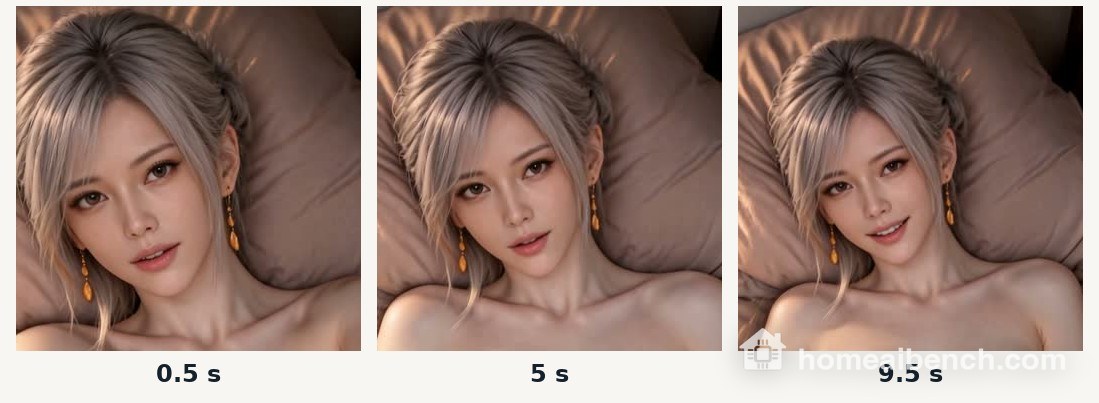
Wan 2.7 reference-to-video was not usable for our work. Its face held; everything around the face failed. It rejects an aspect-ratio parameter outright — our first submission failed with HTTP 400 before a job was even queued — and its output is fixed 16:9 landscape. The face itself held, but the model read the prompt as a wide full-body shot, leaving the face small in frame, and a specified hand action was not performed. Our portrait production could not use it.
Wan 2.7 Enhanced, an image-to-video model we also have on record, makes the same point from the other side: face detail clearly above the 480p Wan 3.0 output, but it rejects end-frame and aspect-ratio parameters, and in two attempts it dropped one half of a two-part simultaneous action, performing only the other half. Sharpness is not control. For our chained work with compound actions, it was the wrong tool.
The perfect reference problem
Encouraged by the trial, we assembled a five-act block — about 50 seconds — with Wan 3.0 reference-to-video, as the start of a planned 16-act film: the trial clip as act one, plus four new acts. Every frame check passed. The face matched the reference in all five acts, at every sampled point.
The project's owner rejected the block. The face, in his judgment, was "so-so".
Both verdicts were correct, and that is the lesson. Our checks verified sameness to the reference, and the reference was faithfully held. But the reference itself was second-tier: a hosted-model portrait, not the face our own character LoRA produces — the LoRA of the earlier notes — with hair leaning silver-grey besides. Reference-to-video had preserved the reference faithfully, flaws included. The method does not improve identity. It preserves the input, and the bottleneck moves from generation to reference selection — a problem that sits upstream of the video model entirely.
What we use now
The long film went back to the keyframed chain, reusing keys from an earlier production of the same film — a chain in which the same face had already survived 26 acts and a dozen rebuilds. The reference route is shelved for this character, not abandoned: it comes back the moment a champion-grade reference still exists to feed it, because on the evidence of the trial, the mechanism itself was never the weak point.
- Judge a face-holding method against the reference you actually have, not the one you wish you had. A perfect hold of a mediocre reference is a mediocre result, faithfully delivered.
- At per-clip price parity, choose on control. Both Wan 3.0 routes cost $0.65 per clip. What differs is the control model — chaining offers pinned endpoints and per-act gates, reference offers independence between clips — and the review labour each one demands.
- Face checks are necessary and not sufficient. They inspect one region at sampled moments; defects live elsewhere and elsewhen. Budget the review time for full-duration, full-frame checks.
- When a model rejects your control parameters, it is telling you what workflow it wants. An end frame refused and an aspect ratio refused are specifications, not obstacles. Every fight we had with a refused parameter ended in a resubmission; every accommodation ended in a clip.
- Checks and verdicts measure different things. Our checks could confirm a face was the same as the reference. Whether the reference was worth being the same as is a judgment no check can make — that one stayed with the owner.
Methods
*Clips are nominally 10 seconds (outputs run 10.0–10.1 s). Chain and reference trials used Wan 3.0 and Wan 2.7 models on a hosted video API; the two reference models' prices were confirmed by quote before submission, and other prices are the rates charged. Face checks sampled frames at 0.5, 3, 5, 7 and 9.5 seconds for the Wan 3.0 reference trial, and at 0.5, 5 and 9.5 seconds for the Wan 2.7 trial and each act of the five-act block. Full-duration checks with close zooms are the standing rule for production acts under gate 3. Likeness verdicts are the project owner's; the checks measure sameness to a reference, not likeness to the character.*